Showing posts with label Final Fantasy X. Show all posts

Tuesday, October 14, 2014

Final Fantasy X and Final Fantasy X-2: Summary and Rankings

Since it would be somewhat foolish to rank Final Fantasy X against itself, I have decided to do my first rankings post as a combination of both games. First though, the summaries.
An ad for the HD remaster limited edition. I think I got this... but the packaging was white instead of black, it doesn't look quite as cool.
Final Fantasy X/ HD Remaster
2001/ 2014

Developer and Publisher: Squaresoft/ Square Enix 
Exec. Producer: Hironobu Sakaguchi (The creator of the Final Fantasy series)
Director: Yoshinori Kitase

I honestly don't want to list all of the staff involved... it's on wikipedia. However, I do plan to reference names in future games that relate to old games. I believe most of the staff was the same for Final Fantasy X and X-2, which makes sense, doesn't it?

The biggest shake-up staff-wise is that this is the first main series Final Fantasy game where the music was not entirely composed by Nobuo Uematsu. I'm quite curious how much music was written by him for the game. My gut tells me not much, as it lacks his style to my ear.

X is the first Final Fantasy game for the PS2, and as was the case with the first PS game, some major changes were made. In the case of FF7 for the PS, it was moving from 2D sprites to 3D polygons. In the case of FF10, it was the addition of voice acting and the loss of the traditional "overland map" of the previous games. Despite some apprehension by fans over the addition of voice acting, the game was well received.

BAM! Summary... I may add more to this later, I don't know.
Hey look! Here is the cover I have.
Final Fantasy X-2/ HD Remaster
2003/ 2014
Developer: Square
Publisher: Square Enix (I believe the original game was released after Square merged with its rival Enix, the publishers of the Dragon Quest [Dragon Warrior in the US] games.)
Exec. Producer: Hironobu Sakaguch
Director: Motomu Toriyama
Producer: Yoshinori Kitase

As I probably mentioned earlier, making this game was a massive departure for the series, as until this point Final Fantasy had had no direct sequels using the same characters and world as a previous installment. It turned out to be a shrewd move though, I assume as a way to counteract the rising costs and lengthening development times as games became more complex. Basically, by re-using the world, characters, and art, this game could be completed much faster than a full new installment in the series. I'm sure fans were skeptical as this turned the previous design philosophy on its head, but once again, even despite a huge change in tone for the series, the game was generally well received.

The biggest staff shake-up is again in the music department. This time series vet Nobuo Uematsu is entirely absent,  "replaced by Noriko Matsueda and Takahito Eguchi of The Bouncer fame" (From Wikipedia). The Bouncer being another Square title for the PS2.

I read somewhere that one of the design goals of 10-2 was to have enough content that it could be the last game you'd ever need to buy. Which is funny, because that doesn't seem good for business, but it is an admirable goal, none-the-less. However, as you might expect, jamming so much content (including tons of mini-games) into a title means the quality of these little features ranges from great to down right awful. In the end, I think they would have been better off leaving the worst stuff out, as the core of the game is good.

Okay, on to the good stuff! The rankings...

Mechanics - Honestly, both games are solid here, but I prefer turn-based combat so much more that 10 easily has the edge.
1. Final Fantasy 10
2. Final Fantasy 10-2

Storyline - 10-2's story of Shuyin and the tragedy of his love is decent, but can't hold a candle to 10's with its epic tale of a religion gone horribly wrong over 1,000 years.
1. Final Fantasy 10
2. Final Fantasy 10-2

Atmosphere - Let's see, both game's take place in a world with a rich and mysterious history, but 10 reveals it, while 10-2 turns it into a Charlie's Angels, J-pop, magical girl power fest. I think you can see where this is going.
1. Final Fantasy 10
2. Final Fantasy 10-2

End Game - I mentioned in my posts that both times I've played through 10 it let me down at the final boss, and the whole auto-life thing in the battle with Yu Yevon is just a fiasco in my opinion. 10-2 Has some nice battles with Vegnagun leading up to a refreshing battle with a sword-wielding Shuyin.
1. Final Fantasy 10-2
2. Final Fantasy 10
This dude means business!
Difficulty - More options means more complexity, which can lead to higher difficulty. Mix in some non-linearity and you've got 10-2. I appreciated the "job" system for sure, but the openendedness did lead to some frustrations as I encountered foes that whooped my ass without notice, or mercy.
1. Final Fantasy 10-2
2. Final Fantasy 10

Balance - Not surprisingly since I gave 10-2 the nod for being more difficult, 10 is on top here. I found the game to be quite pleasant in it's level of difficulty. It was just challenging enough to be rewarding, the way I like it.
1. Final Fantasy 10
2. Final Fantasy 10-2

Music - I listened to both soundtracks while writing and preparing these last two posts. 10's is a good, fitting mix, however, 10-2 has a lot of groove, style, and is more cohesive, and that puts it on top.
1. Final Fantasy 10-2
2. Final Fantasy 10

Art - Both games unsurprisingly have a similar look, as they were developed close to eachother at the same company. However, due to 10-2's whimsical visuals and ubiquitous fashion faux-pas exposed underwear, I have to give the nod to 10.
1. Final Fantasy 10
2. Final Fantasy 10-2

Let me see that tho-o-ong! Actually... I'd really rather not.


Best Villain - Final Fantasy 10's representive to me is definitely Yunalesca, it blew my mind a bit having the ultimate icon of good and righteousness end up being an adversary and being killed by the party! 10-2 has much less in the way of exciting villains, so Shuyin gets the nod somewhat by default. (Leblanc anyone? I don't think so...) Yunalesca is a much more interesting foe.
1. Yunalesca (FF10)
2. Shuyin (FF10-2)
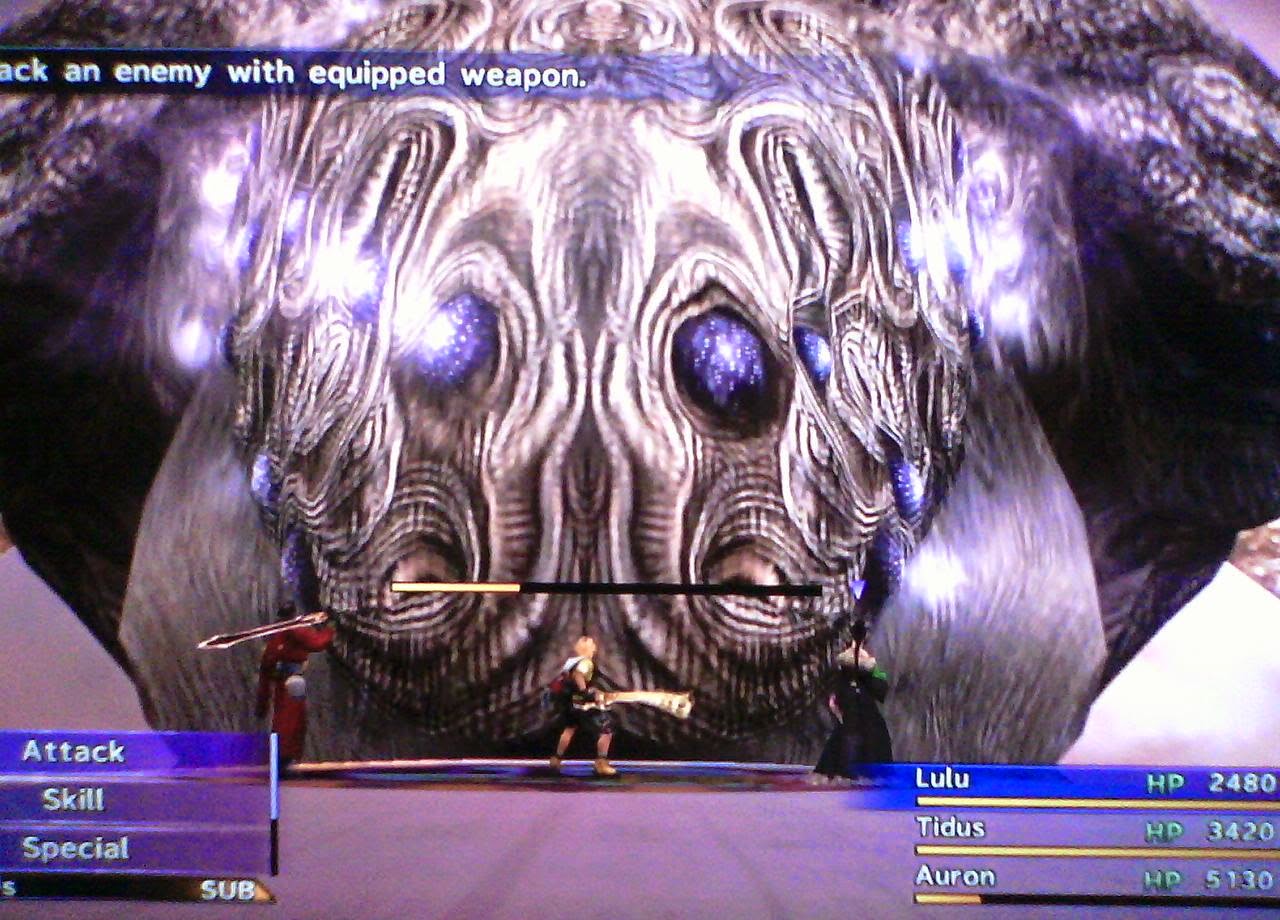
Part of the fight with Yunalesca.

Worst Villain - Yu Yevon will work for 10. He has a very interesting back story and is the source of Sin, but turning out to be a tiny floating bug thing was pretty anti-climactic. Leblanc fits for 10-2. I don't think her over-the-top character is out of place for the tone of the game, but she's just... a little much. I'm putting Yu Yevon on top because I can't overstate how disappointed I was with that battle!
1. Yu Yevon (FF10)
2. Leblanc (FF10-2)
The in game Yu Yevon only looks marginally more fearsome than this.

Best Ally - 10: Auron, he's a super-badass, but not afraid to be vulnerable at times. : ) 10-2: This is tougher... Gippal is kinda cool, but even though she probably annoyed some people, I found Rikku pretty entertaining, and her voice acting was done quite well.
1. Auron (FF10)
2. Rikku (FF10-2)

Worst Ally - 10-2 is Shinra, he's kind of funny occasionally, but I think I have a thing against know-it-all arrogant kids... no, wait... on second thought it's Beclam, he's just such an asshole. 10 is harder... I can't think of a "Beclam" off the top of my head. Nevermind, I've got it, Dona... why didn't I think of that earlier? I think Dona's bitchiness outperforms Beclam's assholeness, so Dona get's the nod.
1. Dona (FF10)
2. Beclam (FF10-2)

Best Enemy - I'm going to go with Yojimbo for 10. Granted he has the advantage of also being designed as an Aeon, but his intro and attacks are just too cool. For 10-2 I was going to go with jumbo cactuar, but he lost out due to not having the awesome mustache I identify with big cactuars (ala FF8). So, I give it to Angra Mainyu for being an interesting boss that can be fought at different times in the game, with varying abilities and a hp total that is affected by multiple battles. Mostly it's just for looking cool though, really. Yojimbo wins.
1. Yojimbo (FF10)
2. Angra Mainyu (FF10-2)
Yojimbo... not to be confused with Usagi or Kurosawa.
 
Worst Enemy - Thankfully neither of these games had an enemy that I dreaded fighting every time it popped on the screen. In earlier play throughs of 10 I remember finding certain enemies, like the mimics, very annoying because they had armor and so many hit points. This time around I had Auron's Masamune before fighting them, which has piercing and break damage limit, so I didn't find them to be nearly as annoying. Therefore, I'm going with the guado, who in the middle of the game have that annoying auto-potion ability, and cause an inordinate amount of trouble in the storyline! 

10-2 had some somewhat obnoxious foes, but generally speaking I came up with reasonable strategies after a couple of battles. I'm going with the claret dragon for having the gall to show up and absorb all elements when I had two characters with the tetra-elemental ability! Meaning I couldn't attack without healing it, for the most part. Besides this absorption, its no pushover either.

The claret dragon is much tougher, but the guado are much more annoying, which is the important part of this category!
1. Guado (FF10)
2. Claret Dragon (FF10-2) 
The dragon has to be named after Ohio State running back Maurice Clarett. Am I right or am I right?
Before I rank mini-games and side quests, a quick note. I thought it might not be fair to rate these categories until I had completed a game 100%, but I've come up with a compromise. I'll simply come back and edit the ranking if I discover something that warrants a change in the future, otherwise I'm ranking the game on what I've experienced so far.

Best Mini-Game - Blitzball is a no-brainer for 10, the mini-game isn't quite deep enough to stand on it's own, but to be honest, it's close. I've happily sunk 10s of hours in on blitzball alone. 10-2 has a glut of mini-games and side quests. I think my favorite is a rather simple one though, leading the people out of the Cavern of the Stolen Fayth, and having to figure out how to manage their "eccentricities." Blitzball, with its breadth and depth, takes this category.
1. Blitzball (FF10)
2. Cavern of the Stolen Fayth (FF10-2)

Worst Mini-Game - These categories are unfortunately easier to pick than one would hope. 10 is a close race between the sanity destroying chocobo trainer and the lightning dodging. Seriously, f' these "mini-games", the're more like exercises in masochism. Lightning dodging takes the cake because while it's probably equally frustrating, it takes longer and is more tedious.
FF10-2 has plenty of crappy mini-games, but I have to give the nod to Spherebreak because it seems like it's supposed to be the next big thing, like Blitzball, but it plays like mediocre educational software.
Lightning dodging wins because... well hell, I wouldn't be surprised if it stays on top forever.
1. Lightning Dodging (FF10)
2. Spherebreak (FF10-2)

Side Quests - Both of these games have good extra content. I'll give 10-2 the nod because it has SOOO much going on. You could play this game a long time and still find new stuff, if you so desired.
1. FF10-2
2. FF10

Overall - And here it is, the grand-daddy of all categories. As I've said, both of these games are great, but it probably won't surprise anyone that FF10 is on top. The mechanics, story, and atmosphere are all vastly superior in FF10, making it the clear winner here.
1. FF10
2. FF10-2
Congratulations, Final Fantasy X... a winner is you!

First ranking done! Phew, that was a lot more work than I anticipated actually, but granted I was coming up with rankings for two games at once, so not a problem. Hopefully, you, dear reader, find it as interesting and entertaining to read as it was to write! Stay tuned for more... here at This Bard's Tales.

 

Wednesday, July 9, 2014

Final Fantasy X, 11: Fin.

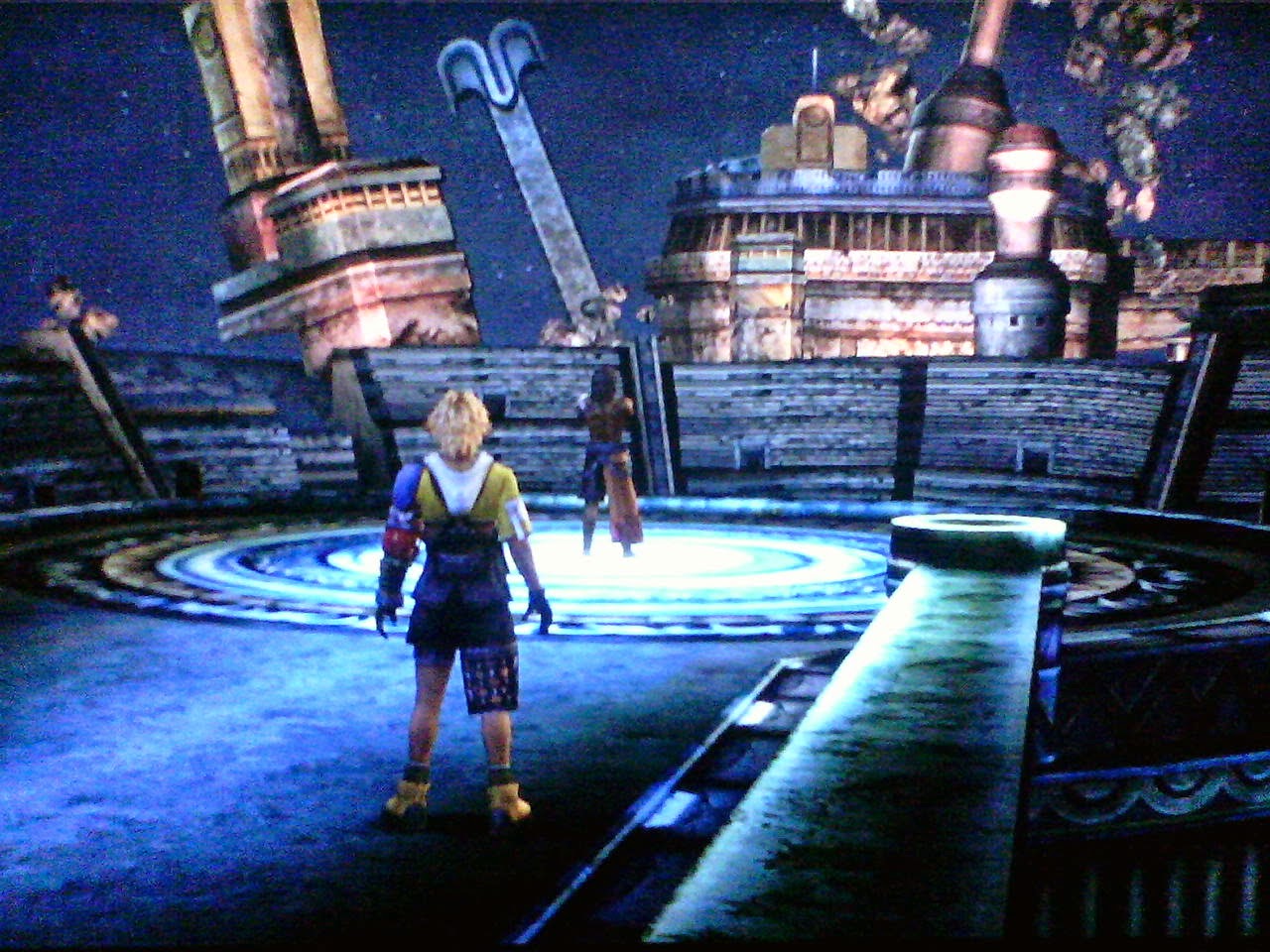
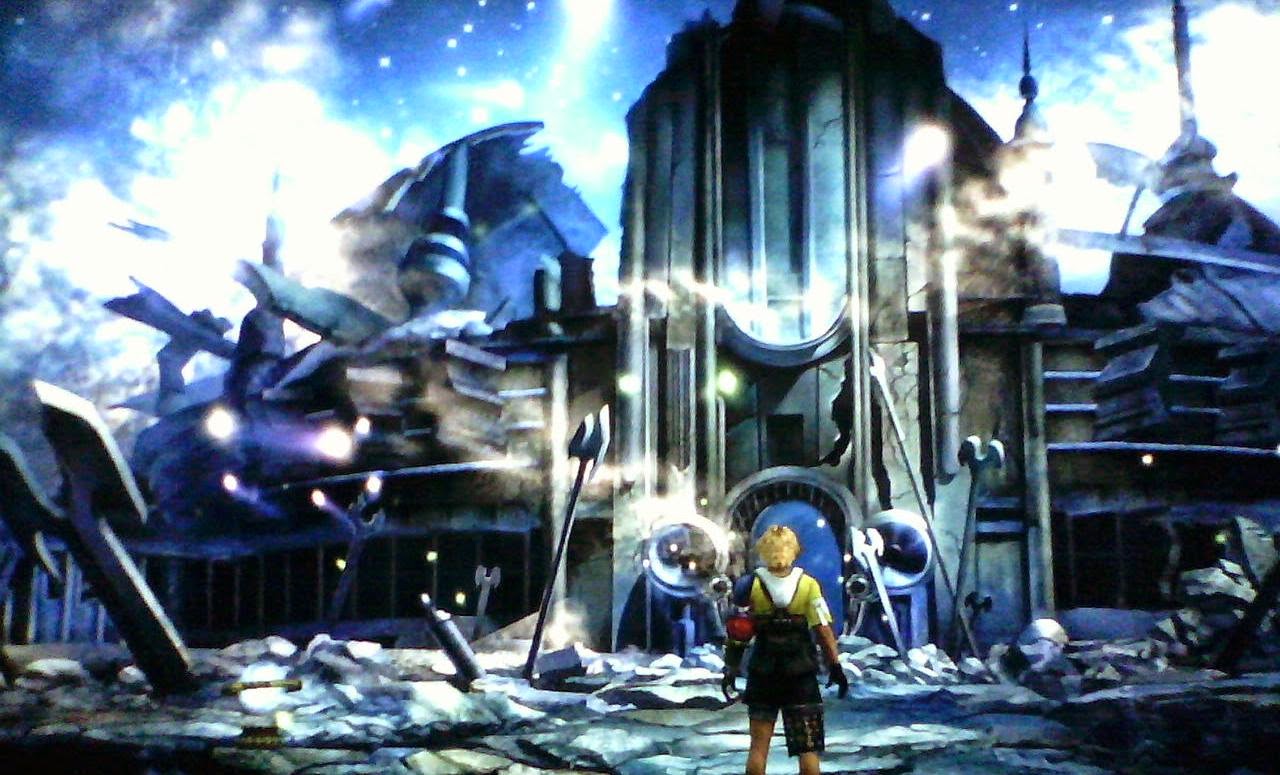
Our heroes made it to Zanarkand, the goal of the pilgrimage. However, what awaited them there?

The ruined "dome" in Zanarkand. It bears a resemblance to the blitzball stadium depicted in the game's opening sequence.
Although it's not the end game, I think the guardians arrival in Zanarkand is the climax; certainly so of the storyline. The storyline builds and throws twists at the player relentlessly, and gaining the "Final Aeon" is no exception. Final Fantasy X boasts a fleshed out world with a very interesting and detailed background. I considered summarizing it here for those who might not wish to play the game, but in the interest of blog time, and to not spoil it, I'll just recommend playing the game. If you hate playing games like this with a passion and just can't see yourself giving it a go, I think the story is worth a read honestly. There is likely a summary up somewhere on the 'nets. I can't resist a little tease, basically everything that the Yevonites of Spira have been taught to believe in is built on half-truths and political rhetoric, and it all comes to a head dramatically in Zanarkand.

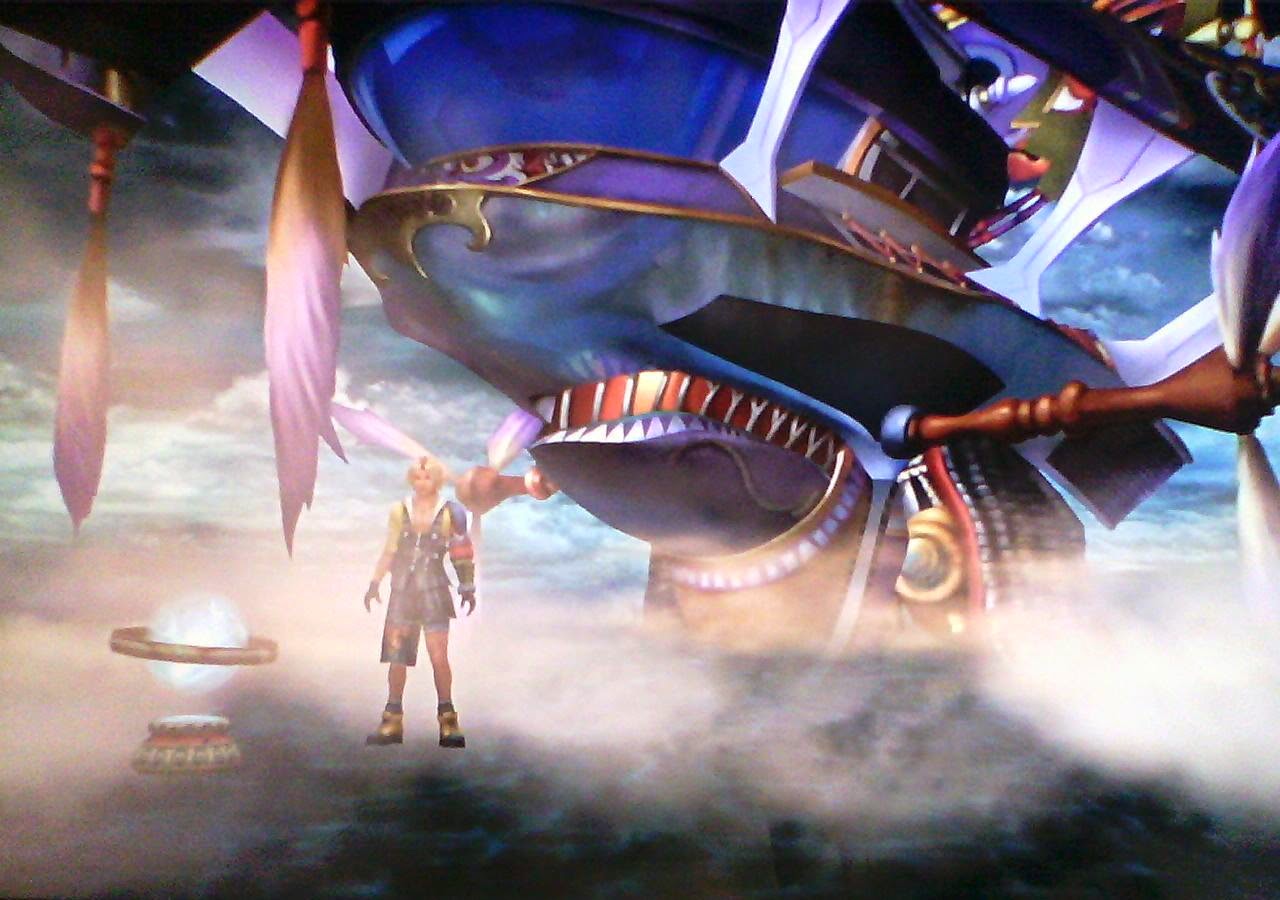
After Zanarkand, the heroes now must seek a way to defeat Sin. First, they make Sin somewhat docile by encouraging all the folk of Spira to sing a song, "The Hymn of the Fayth". This is a song sung by the fayth themselves that Tidus's father particularly liked. Once Sin is calmed, the guardians attack with the airship's help, and fight a triple battle with Sin.

"We're gonna get you Sin!"

"Oh good Yevons!" If the guardians do not defeat Sin before it's overdrive gauge fills, they are met with probably the only instant game over in the game.
These battle sequences depict for the first time in the game anyone having any real success battling Sin. It's interesting, for the first time the characters, and you, feel like Sin might be on the ropes and there is some chance of defeating it. This contrasts sharply with the rest of the game, where Sin seems invincible, and inevitable.

The airship drops the heroes off inside Sin, at the "Sea of Sorrows."
Like most of today's RPGs, FFX has an auto-map feature that displays on screen. Being how this is my third time through the game, I turned this off to increase the challenge a little, and increase the fun of exploration a little too. However, the Sea of Sorrows was the first place I had to turn it on to make it. The camera angles shift at intersections, and it was just too hard to keep my bearings without it.

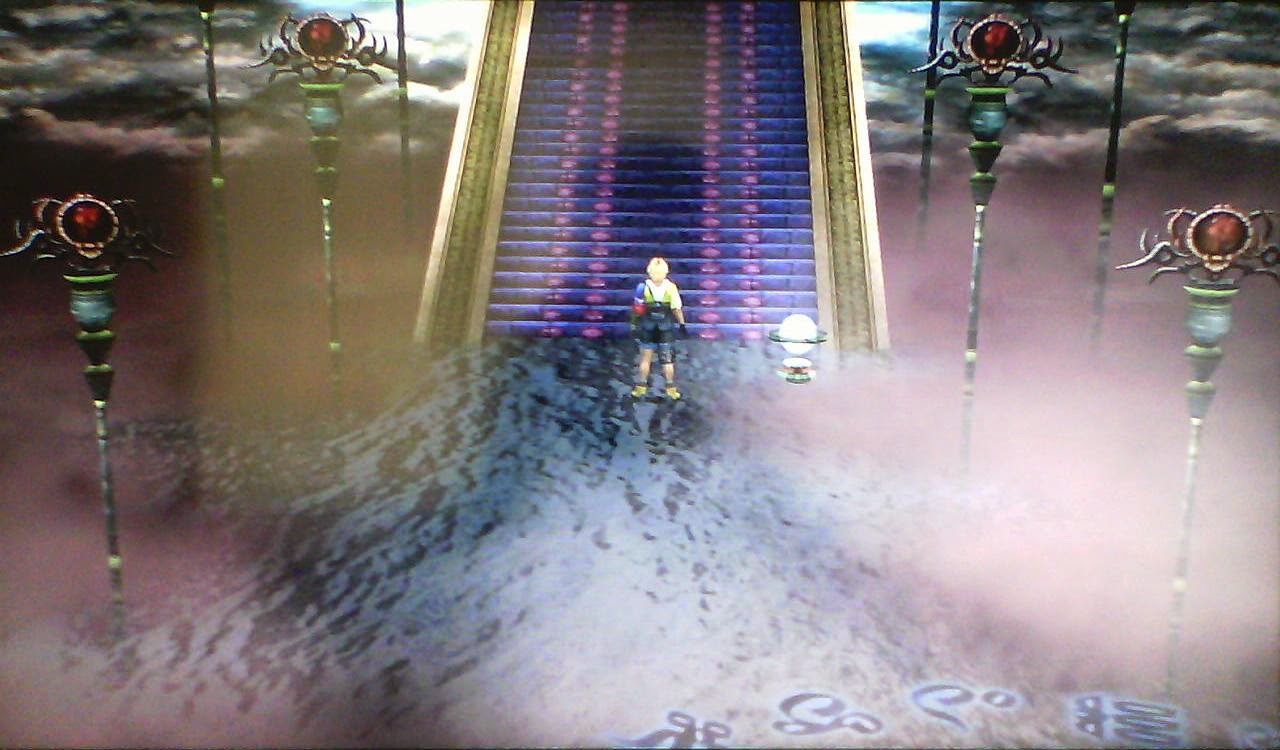
The mysterious stairs exiting the Sea.
The final battle with Seymour acts a capstone to the Sea of Sorrows. He is an interesting character, he is a dark embodiment of the Buddhist idea that living is suffering. However, unlike the Buddha, he believes that suffering is only escapable by death. He wishes to be Yuna's final aeon, and thus become Sin, bringing the escape of death to Spira. The guardians have something to say about that plan, though.

I didn't get a screen cap of this final incarnation, Seymour Omnis. It illustrates a great thing about combat in this game though, combining traditional combat with puzzle elements. Seymour is accompanied by large discs behind him which the player can manipulate by attacking them. The position of these discs determine Seymour's attack pattern and how powerful it is. Seymour can move them as well, otherwise the battle wouldn't be very challenging of course.

Following the Sea of Sorrows is the City of... something I don't remember. There is one monster that only shows up here that I have always been very curious about. It's called barbatos. I believe barbatos is the name of a demon, however, I've of course (for me) always been curious if it has some connection to the name of the country Barbados. For example, if Christian explorers arrived their, met some difficulty, and proclaimed it home of the demon Barbatos, that sort of thing.

I love these old school demon illustrations.
From Wikipedia: "In demonology, Barbatos is an earl and duke of Hell, ruling thirty legions of demons and has four kings as his companions to command his legions. He can speak to animals, can tell the future, conciliates friends and rulers, and can lead men to treasure hidden by the enchantment of magicians. His name derives from Latin barbatus, meaning 'bearded, old man, philosopher'."

As far as the etymology of the country's name: "The origin of the name Barbados is either the Portuguese word Barbados or the Spanish equivalent los Barbados, both meaning "the bearded ones" It is unclear whether "bearded" refers to the long, hanging roots of the bearded fig-tree (Ficus citrifolia), indigenous to the island; or to the allegedly bearded Caribs once inhabiting the island; or, more fancifully, to the foam spraying over the outlying reefs giving the impression of a beard." So there you go! My hunch was correct, there is a connection between the two names, if not as sinister as I originally hoped.

After the City of... Dying Dreams I found out it is called, the guardians enter a giant tower and an area called the "Nucleus" which is very peculiar. The camera rotates slowly, and you must collect a number of crystals that form in the air, while crystalline stalagmites pop up randomly. If a stalagmite hits you, you go into battle. It's not a bad little puzzle but it's really strange, as there is nothing else in the game similar, and it pops up out of nowhere with no explanation. This area leads to the final boss. Like I said, it's not bad, I just don't get what they were going for with this section.

Tidus reunites with his father...

...and promptly kills him. Well, kills him in the form of Braska's Final Aeon, anyway.
Storyline wise, Tidus reunites with his father, but then is forced to battle him in order to defeat Sin. The whole scene is done well, and tugs at the heart strings. I won't detail all that though. I have few beefs with this game, but unfortunately the series of final battles is one of them. Having a series of final battles that live up to the hype is a staple of Final Fantasy's, and something they generally do very well. I've gathered from walkthroughs that Braska's Final Aeon can be a tough battle, however, both times I've fought him I had a Bahamut overdrive in reserve, and he went down quickly with a mega flare or two. It was a little anti-climactic. Granted, if you don't have Bahamut on overdrive, maybe it wouldn't be so easy, I don't know. I'm glad they didn't resort to the quick fix of giving him an instant aeon kill like some other bosses have, because that just feels unfair. Perhaps the Final Aeon should have had some more HP though, or a higher defense against the massive damage overdrives.

Now, the first time I played, I was not disappointing by this fight, because I knew the real big baddy was coming; that being the mysterious Yu Yevon. That name starts popping up near the end of the game, and I had a sense by the end of the game that Yu Yevon was going to be an epic battle with an ultimate badass. Then came the disappointment... the problem here is simple, in the battle with Yu Yevon, your party has the "auto-life" ability, meaning you CAN'T LOSE! I think this takes all the fun out of it, it seems pointless, a challenging battle instead becomes monotony. Even if the battle is relatively easy, having the chance that you could be defeated over your head makes all the difference. So, I think the designers really made a big mistake here, sucking any potential challenge, and fun, out of the final battle. Despite my misgivings about the final battles though, it is important to note that I think the game's strengths more than make up for these pit-falls.

There it is folks! After a month and half and eleven posts, I've finally blogged to the end of the main storyline of Final Fantasy X. There is, however still a lot of content left in the game in the form of side quests, and I'll be covering those intermixed with my posts on other games. Also, I'll get the hang of pacing my gaming and blogging as I go along here. Expect less posts to get through most games, or at least posts that keep up with my actual play time. Overall, I still think FFX has great gameplay and a fantastic story, and I highly recommend it.


One final note on this game is that as I played, I noticed something I hadn't ever before, that is, similarities to Final Fantasy 13. It makes sense, of course, since this is my first post 13 play through. Basically FF13 was panned for having extremely linear gameplay and dungeons. I noticed that FFX's dungeons are super basic, just like 13s, often being a long strait line with one or two branches. I'm not sure I could describe tangibly why, but it just seems that FFX works, and FF13 doesn't. It's like X toes the line, and 13 took it too far. I'm intrigued by this comparison though, so I plan to play FF13 next in the Final Fantasys, after X-2, to see if I have any new perspective on it. I'm going to play X-2 immediately next, so the storyline it continues is fresh.

I haven't been doing a lot of posts on the old school gold box games, but rest assured those will continue as well, hopefully a little more regularly.

Although some guardians had come, and some had gone, in the end, Sin was both defeated, and Yuna's life saved. Although, the tale of Spira, and the stories of the guardians did not end here. Thank you for joining me friends, for the epic tale known as Final Fantasy Ten. There is yet more to come, next time... at This Bard's Tales! 

Final Fantasy X Remaster, 10: Game Balance and International Versions.

       The guardians get a momentary respite at they travel the Calm Lands. However, trouble is close behind as they reach the sacred mountain, Gagazet.

       Okay, so this blog is relatively new, and here is where I admit that I'm still figuring out the best way to pace my playing with my blogging. Obviously, the way I've been blogging FFX has been less than ideal, since the quality of what I have to say has certainly taken a hit, being that I'm reflecting on experiences I had over a month ago now, if I recall. So, I'm hoping to wrap up the notable elements of the "main quest" (That is, besides "side quests") all in this post, and get the blog back on track with my game playing.
       The Calm Lands I talked about in my last post as a place where some new monsters show up. The game had been relatively easy up to this point, but pleasingly so. I was not having much difficulty because I knew the correct strategies to defeat enemies. This is the sort of gameplay I like. In FFX, you have some leeway for trial and error to figure out the best way to defeat your opponent without losing. Once you've got a good strategy, it's relatively easy. Contrast this to FF13 and many other games where the trial and error portion involves fighting and losing a battle many times, than reloading. Uggh, I hate that sort of gameplay, it's unfortunate that it seems to be the trend that games are moving toward. FF13 even builds this in with a "retry" option in battle, wtf? Admittedly, I may have a bit of a bias from tabletop games where I feel like if I "die" or "lose" a battle that I didn't do something right, and that I should be able to win battles without having to reload if I'm a good player. 
      A good example of what I'm getting at is the contrast in gameplay from Pool of Radiance to Pools of Darkness. In PoR you can wander around, and generally speaking, use your resourcefulness to get yourself out of any sticky situations (good game balance). PoD throws massive, deadly battles at you, and you just have to hope for the best... then reload (not good game balance). Oddly enough, at the time I'm writing this I'm a good deal into FFX-2, and the two games have a similar contrast. FFX has a turn-based, strategy heavy combat system. FFX-2 has a real-time strategic system, but it just seems like you're holding on for dear life trying to come up with the right combination of abilities, and often just end up button mashing... and hoping for the best.

Seymour attacks again on Gagazet. Total Annihilation? Hmm, that sounds best avoided.
      All that being said, the Calm Lands and Gagazet were where I started to have difficulty. An almost defeated malboro (I was trying to capture it, if I recall) handed me my first game over. This was over 30 hours in, without a defeat. Some might call that an easy game, but in this case I call it well balanced. The key is that there were some close battles, but I was always able to dig my way out and come out on top. I've heard a lot of Joe Internet complaining/bragging that Final Fantasy games, JRPGs, etc. are sooo easy, but part of me wonders how much of that is just simply based on expectations. If you expect to die Wizardry, or even Gold Box style, Final Fantasys might seem easy. However, if you expect NOT to die, they might seem just right. 
      On a side note, I've played a lot of Dark Souls, and feel the devs there really found a sweet spot in terms of deaths and gameplay. Death in an RPG isn't so aggravating if you don't lose your exp and items. Honestly, I think even keeping exp is enough, otherwise a defeat just feels like a waste of time since your last save. Take notes developers!

This massive beast is a member of another great Final Fantasy pedigree, the flan.
      So, FFX became a bit of a grind on Mt. Gagazet. The enemies were tougher than I remembered, and there was a very high encounter rate. It's notable that the remaster of the game is based on the "international" version of FFX, and features a new sphere grid option. The sphere grid is how you develop your characters in the game. Without going into too much detail, I was using the new "expert" sphere grid that allows more options for the characters. This also means I may have developed them less optimally, accounting for the increased difficulty than I remembered. All that being said, although the mountain got a little aggrivating at points, I did feel like I'd really accomplished something tough after making it through. I felt like it was actually the test of the summoner's abilities that the game's story hypes it up to be, and I came out on top. It was a nice unintentional RP moment for me, actually.
      There is so much to dig into in these games, I feel like a quick explanation of the "international" releases is in order. Essentially, some of the games have been released outside of the US with additional features (In this game's case, the extra sphere grid, and extra mega-bosses), possibly to make Europeans and Australians feel better about their release date being later than the US and Japan. Then, in true cash cow fashion, these additional featured games (along with english audio, if I recall) are released in Japan as the "international" version. That pretty much sums it up.

  Feeling exhausted but triumphant after scaling the massive mountain, the guardians faced yet more trials within the caves leading to the mountain's peak, and to their eventual goal... Zanarkand.

The cave holding the trials of Gagazet.
           
The guardian at the mountain's peak.
  There is a very nice sunset background as the guardians decend into Zanarkand.


 Then, once the guardians reach the base of the mountain, it's a starry night.

Which, admittedly, this screen shot does not show too well.
     Given that the Final Fantasy games don't have a day/night cycle like Ultima or Dragon Quest, I cynically expected to go back a screen and have magically gone back in time to sunset. Kudos to the devs for thinking of that, the sky on the previous screens was now awash with stars. Incidentally, I generally dislike the word "kudos", go figure...
       So there is just too much more to say about this game, and it's 3am, so... one more post on the main quest to follow! (It would have been cool to end FFX on the 10th post, but hey, whatevs.)

  The guardians have reached Zanarkand. Rikku and Tidus are no closer to finding a way to avoid Yuna's death. Will she end up sacrificing herself in the name of peace? Find out next time... on This Bard's Tales!  

Final Fantasy X, Remaster 9: Bevelle, Bahamut, Coeurl and Malboro.

 The guardians fought on to save Spira, heading to Bevelle aboard their newfound airship. However, the great dragon Evrae, guardian of Bevelle, stood in their way. They fought the dangerous beast aboard the deck of the airship, with Cid firing volleys of missiles to support them.

 Circling the great city of Bevelle is a dragon the guardians must fight. Their is a funny moment here, as the Al-Bhed Rin offers items to help the party fight off the dragon, that pokes fun at RPG tropes. Wakka says "We gotta pay? If we lose you die too buddy!" Rin counters with,"I have faith in your victory." I really enjoyed it, after all, it's just sort of accepted in RPGs that even though you are the heroes who will save the world, you often start with little equipment and experience, and must earn your own keep, however little sense it might make. Rin is one shrewd businessman indeed.
  While in Bevelle, Yuna receives the "grand daddy" of Final Fantasy summons, a powerful dragon that goes all the way back to Final Fantasy 1, Bahamut. Bahamut has always been represented as a dragon in FF (Bahamut is also a powerful god of dragons in the Dungeons & Dragons mythos), which is notable because of the etymology, but I'll get to that momentarily.
  Bahamut first appears in Final Fantasy I, although not in his typical role as a summon. In this game, he is the King of Dragons, and rewards the party for a particular quest by upgrading their classes. Fighter becomes Knight, Black Mage becomes Black Wizard, and so on. When the summons were introduced in Final Fantasy 3, Bahamut was the most powerful of them, and the rest is history. Although more powerful summons were introduced in later games, each one is generally specific to it's game (for example: FF8's Eden, FF9's Ark, FF10's Anima). Bahamut is the most powerful that exists across multiple games.
Bahamut imparts the class change in a FF1 remake.
Bahamut's fayth.

  The origin of the name, from The Final Fantasy Wiki: "Bahamut originated as an enormous whale in ancient pre-Islamic Arabian mythology. Upon Bahamut's back stands a bull with four thousand eyes, ears, noses, mouths, tongues and feet called Kujuta. Between each of these is a distance of a 500-year journey. On the back of Kujuta is a mountain of ruby. Atop this mountain is an angel who carries six hells, earth, and seven heavens on its shoulders. Another version of the Arabic story is that Bahamut is indeed a dragon and he stands on a whale called Liwash. In modern times, the game Dungeons & Dragons is responsible for re-imagining Bahamut as the king of dragons, a benevolent Platinum Dragon; the opposite of the malevolent Tiamat, the five-headed Chromatic Queen of Dragons."

  Now, I've seen an image depicting Bahamut and Kujuta as described above, however, my image searches just brought up pop-culture related items. So you get the artist's interpretation below.

Bahamut.
  The guardians must escape from Bevelle, after being sentenced to death for their supposed treason and murder. Oddly enough, Seymour is present for the trial of his own murderers, but such is the way of Spira, named for its spiral of death. The guardians find that Spira is crawling with the unsent, those who have died but refused to go to the Farplane. Over time the unsent lose more and more of their humanity, and become fiends. I found this a very interesting bit of background, as it gives a reason why Spira is overflowing with monsters, which is often left as an assumed status quo in RPGs.

The summoner Isaaru seeks to stop Yuna's escape from Bevelle. She calls Bahamut to aid her.

Escaping Bevelle also marks the first of many battles with creepy Seymour transformations.

  After the wild battles in Bevelle, things calm down for a moment as the guardians reach, the Calm Lands. Here on these wide open plains are a couple of monsters which harken back to past Final Fantasy games, the coeurl and the malboro.
  Both of these creatures made their first appearance in FF2, a game which while being a bit of a black sheep due to its leveling system, was the first appearance of a whole slew of monsters, characters, etc., that have become staples of the series. The coeurl is a magic cat... with tentacles. It usually has an attack called "blaster" that can be devastating, by either paralyzing or killing its target. The origin of the coeurl once again illustrates why I'm doing this, it comes from a science fiction tale I had no knowledge of. From Wikipedia:  "Coeurl is a fictional alien race of predators created by science fiction novelist A. E. van Vogt (1912-2000) and featured in his first published short story "Black Destroyer" (1939), later incorporated in the novel The Voyage of the Space Beagle (1950). Its appearance is comparable to a large cat, except that its forelegs are twice as long as its hind legs, and it possesses tentacles attached to its shoulders which terminate in suction cups." No s...! That is a cool find. Also from the same page,  "The displacer beast in the Dungeons & Dragons role-playing game was inspired by the coeurl the two have the same idea of tentacles coming from the shoulders, as well as a feline appearance, and the displacer beast uses 'vibrations' to confuse its enemies." Interesting stuff.

Final Fantasy X's Coeurl.
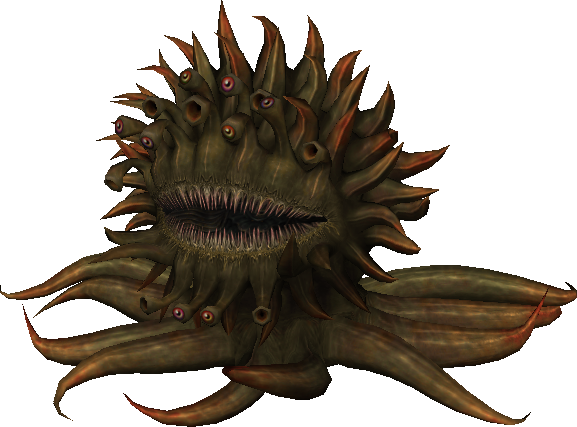
  Next up is one of my personal favorites, although certainly not my favorite to fight in game, the dreaded malboro. These tentacled monstrosities again first appeared in FF2. Their ability to use an attack called "bad breath" that causes numerous status effects, makes their mere appearance in battle strike fear in the heart of any Final Fantasy veteran.
Run away... Run away!
   Final Fantasy Wiki has a few theories on the origin of the name: "A likely possibility is that it comes from the Japanese onomatopoeia "boro", which is the sound of an upset stomach. Their name may also be derived from the Latin and Greek words "mal" (meaning bad) and "boros" (meaning breath), a reference to their infamous attack. The name could also be a reference to Marlboro Cigarettes, since the creatures often spew horrid-smelling fumes." I say the first two theories are hogwash, and firmly believe in the third. It's a gross monster that spews "bad breath" and its name is malboro, which I think omits the "r" only to avoid a lawsuit. I mean, that's just too good to be a coincidence, right? Its a much better anti-smoking ad than American tax money has ever paid for.
  Incidentally, it's my understanding that Marlboro Cigarettes were originally marketed to women in the US, and in fact they are a popular women's cigarette in Japan. Take that Marlboro Man.

  Despite the odds being firmly against them, the guardians escaped death in Bevelle. To find out their fate, return next time for... This Bard's Tales!  
 

Monday, July 7, 2014

Final Fantasy X Remaster, 8: Bikanel, Zu, and some Final Fantasy tropes.

 Shaking off the last vestiges of Sin's toxin, Tidus awakened. Strange sensations assaulted his body as he reluctantly opened his eyes to be greeted by the piercing light of the noon sun. Somehow, he was floating in a small pool, surrounded by mountains of shifting sand. Staggering about in the blistering heat, he looked for any sign of his friends.


 After reuniting with his friends, Tidus finds out that he is on the remote island of Bikanel, home of the Al-Bhed. Now, I've always wondered if this series of events is an homage to Final Fantasy IV. In FFX, Tidus washes up in an oasis on an island, surrounded by sand dunes... and fights giant birds called Zus. In FFIV, Cecil washes up on an island, surrounded by a sandy beach... and fights giant birds called Zus. It's hard to say whether this is purposeful, but I like to think so.

He fights them on the beach too... I'll get the appropriate screen cap when I play FFIV.
    Zus are a staple enemy, appearing many times in the series. The etymology appears to stem from Mesopotamian lore. From Encyclopedia Mythica: "In Sumero-Akkadian mythology, Zu is a divine storm-bird and the personification of the southern wind and the thunder clouds." That's a pretty self-explanatory association for this one.
 The storyline continues to heat up on Bikanel, as this is where Tidus, who has been blissfully unaware up to this point, finds out something key to the summoner's pilgrimage. The summoner sacrifices themselves at the end of the journey in order to defeat sin. Summoning the "Final Aeon" spells the end of the summoner. Tidus is understandably upset, and sides with the Al-Bhed in their quest to end the pilgrimages, thinking that it is simply leading lambs to slaughter for a hopeless cause. The Yevonites believe the sacrifice is worthwhile, if only for a temporary respite from Sin.

 Tidus found his companions spread out in the dunes, and they reunited to head for the Al-Bhed home. However, they would only find it if their only somewhat reliable guide, Rikku, could remember where it was! After some twists and turns, they arrived at what the Al-Bhed had named "Home", however, sirens blared and smoke filled the air. Home was under attack!

This is a semi-secret room in home that has a chest requiring a code to open. It's a neat addition that I didn't remember from my other playthroughs.
 The guardians rescue the summoner's that the Al-Bhed had abducted (albeit to save their lives), but Yuna is not among them. In the end, Home ends up being destroyed, from aboard another Final Fantasy staple... the airship! Getting an airship to travel the world is one of the most exciting points in any Final Fantasy game, which I believe is possible in all of them. The airship is one of the few Final Fantasy tropes that goes back to the original. Even staples like the chocobo riding birds and airship engineer "Cid" didn't enter the picture until Final Fantasy 2. Speaking of Cid, he is an Al-Bhed, and the captain of the airship in FFX.

The airship docked at Luca.
 Since FF2, each game has had a character, usually some sort of engineer, named Cid, who is responsible for getting the party their airship, and often doing modifications on it. Okay, yes, you with your hand up in the back, FF6 has a Cid, but he is not tied to the airship in that game. Exceptions do exist. One of the "tropes" of Final Fantasy is that each game takes place in it's own world, with all new characters. However, their are many recurring themes and names that tie them together. Airships, Cids, and chocobos being a few of them. One notable change in this game is that the airship is not directly controllable by the player. This is, most likely, a necessary evil of not having a walkable "overland map" as their was in previous games. While this design choice may have helped make the world feel more tied together while traveling on foot, the absence of the real time flight is a bummer.  
 Yes again, you, in the back, I know, after Final Fantasy X many exceptions to the unique world started popping up. X was the first game to have a direct sequel, X-2 (Talk about confusing numbering conventions), and FF XII takes place in the same world as previous games Vagrant Story and Final Fantasy Tactics. After the gate opened, the flood spewed through, and there are now prequels and sequels to FFVII, FFIV, and more. Not to mention the remakes... These are all subjects to be discussed over time though, lest I explode the minds of the uninitiated.

 Fleeing from the overrun Home, the guardians now fly the salvage airship to Bevelle. What danger awaits them? Will they be able to save Yuna from the clutches of the dark Seymour? Find out next time... on This Bard's Tales!
       

Wednesday, June 25, 2014

Final Fantasy X Remaster, 7: Macalania and Wendigo.

  When last we were in Spira, the guardians traversed the moonflow on the back of a shoopuf. From there, they made a stop in Guadosalam, home of the guado, and traveled through the Thunder Plains. Lord Seymour was present in Guodosalam, and had a... proposal for Yuna, a very awkward one. It was becoming quite apparent to the guardians that Yevon, and Maester Seymour were manipulating the politics of Spira to their own ends. Although Yuna had not given her final answer to Seymour, the gaudo began spreading rumour that she had said yes. The gaurdians pursued Seymour to his home temple, at Macalania.

The guardians had to travel through the crystal wood of Macalania. Here is a spring, where the water merges with memories and "spheres" are formed, that can be watched to view the past.
  
The entrance to the Cloister of Trials in the Macalania Temple.
  As the guardians caught up with Seymour, his evil intent had been confirmed, there was no choice but to fight him and his guado allies. After the battle, Seymour had apparently been killed, however, before Yuna could send him, the guado burst in, claiming they were murderers! Tidus protested, but to no avail, they would be branded traitors and murderers, and had no choice but to flee for their lives! Wakka perhaps took it the hardest, as he was forced to slay a figure that represented the head of his devoted religion.

The guardians face Seymour's aeon.
 
  Fleeing for their lives, on the frozen surface of the lake, the guardians were assaulted by a gigantic yeti like monster, flanked by two of the nefarious guado. The creature was called Wendigo.

This is the coolest wendigo art I saw online.
  The wendigo seems to be a relatively well known mythological (or is it? Muahaha!) creature. I certainly enjoy my history, but it's kind of refreshing when you run into a creature used in fantasy whose roots are a little closer to home. The wendigo is one such creature, from Wikipedia: "The Wendigo is a demonic half-beast creature appearing in the legends of the Algonquian peoples along the Atlantic Coast and Great Lakes Region of both the United States and Canada. The creature or spirit could either possess characteristics of a human or a monster that had physically transformed from a person. It is particularly associated with cannibalism. The Algonquian believed those who indulged in eating human flesh were at particular risk; the legend appears to have reinforced the taboo of the practice of cannibalism. It is often described in Algonquian mythology as a balance of nature."

  In anger at it's defeat, Wendigo slammed all of it's weight into the icy shelf of the lake, dropping the gaurdians below. They found themselves standing amongst ancient ruins. However, they soon realized these ruins were not typical, they were standing... on Sin itself. The toxin took effect, and all faded to black. To find out how our heroes fare, come back soon... to This Bard's Tales!  

Friday, June 20, 2014

Final Fantasy X Remaster, 6: The Moonflow and Shiva.

  Back on Spira, after obtaining the fayth Ixion from the Djose temple, the guardians next had to tackle the Moonflow, a large river. The Moonflow was unique in many ways, it drew pyreflies in great amounts, lightning up the night sky, and deep beneath it's surface lay massive ruins. 
  Thousands of years ago, the people of Spira had a built a city over the river, however, their hubris outweighed their ingenuity, and the city sank beneath the roiling waters. Yet another example of the punishment for the sin of using machina to ease one's life, at least according to Wakka.
  Perhaps most peculiar of all about the Moonflow was the mode of transport across it. A group of small, bug-eyed fellows called hypello were the caretakers of massive beasts called shoopufs. These shoopufs could swim across the river, with folks riding in comfort upon their backs.

I really love how the hypello say "Ride ze shoopuf?"
   I must admit, a game with as much story as Final Fantasy X has become a bit of a slog to write anecdotes too, because I just find it too hard to skip plot points. I'm going to have to though, otherwise this will take forever! I actually completed the game a few weeks ago, and am working on catching up with the blog. So, for games like this, just keep in mind that there is a lot more depth to the story than I can touch on here. Also, if the story piques your interest, it is probably best experienced by playing the game! In the realm of the Final Fantasy games, this blog is going to be more about analysis and history.

After crossing the Moonflow, the guardians enter Gaudosalam. It is not only the home of Maester Seymour, but also this, the entrance to the Farplane.

Shiva's fayth.


  The next Aeon that Yuna obtains is Shiva, who much like Ifrit, has been a staple of the series since the summons were introduced. Shiva most likely borrows her name from the Hindu religion. The following is from the Final Fantasy Wiki: "Shiva shares her name with the Hindu god, Shiva (also spelled Åšiva). The Hindu Shiva once saved the world by consuming poison, giving him blue skin around the area of the neck and throat. It should also be noted that Shiva is a male god, but can merge with his consort Parvati. Together they become Ardhanari an androgynous Hindu god of duality. Shiva is the god of destruction, along with Vishnu, who is the god of preservation, and Brahma, the god of creation. Together they are the three principle deities of the Trimurti (Hindu Triad). Also, in paintings Shiva was frequently mistaken for a woman due to his long hair and facial features."

A statue of the Hindu god Shiva, showing somewhat effeminate features.

  Beyond the Moonflow and Guadosalam, the guardians traversed the frozen temple where the fayth of Shiva slept.. However, many alarming things happened once they reached the home of Maester Seymour... to find out more, come back next time... for This Bard's Tales!

Wednesday, June 18, 2014

Final Fantasy X Remaster, 5: Mushroom Rock and Ixion.

  Welcome friends, tonight we go back to Spira, where in the aftermath of the failed Operation Mi'hen, Auron suspects foul play. To him, the operation was allowed by Yevon as a political move to consolidate it's power. Those who disobeyed the teachings were slaughtered by Sin, bringing many who had strayed back to the teachings, and thus consolidating power with Yevon.
  The horrors of the operation behind them for the moment, the guardians continued their pilgrimage up the Highroad, on their way to Djose temple.

The bridge to the temple at Djose.


   The temple at Djose was special in that it lay within the "Lightning Mushroom Rock." It was a huge stone, that exploded with lightning when a summoner addressed the fayth within. The fayth at Djose was named Ixion. It was a creature much a like a horse or zebra, but with a magnificent horn, and the ability to wield the power of lightning.

The Lightning Mushroom Rock orbiting the temple.

  Ixion, unbeknownst to me, is a figure from Greek mythology. The following is from www.pantheon.org: "He is significant in many respects, but is chiefly known as the first human to shed kindred blood. This occurred when Ixion invited his father-in-law, Deioneus, to come and collect the price that Ixion owed him for his bride. Upon his arrival, Deioneus fell into a pit filled with burning coals Ixion had camouflaged.
   Because this was a crime new to the human race, nobody could purify Ixion and he wandered an exile. Zeus took pity on him and decided not only to purify Ixion, but to invite him to Olympus as a guest. Once in Olympus though, Ixion became so enamored of Hera, and he desired to sleep with her. Zeus did not believe that Ixion would be so disrespectful as to have designs upon the wife of his host. To see if the rumors were true, Zeus made an image of Hera out of a cloud, and impregnated it. The cloud bore Ixion the monster Centaurus, who was unloved by the Graces and had no honor among men or the gods. Centaurus then mated with the mares of Mt. Pelion in Magnesia, and so from Ixion the race of centaurs was born."

Ixion's fayth.

  We can deduce that Ixion's horse like appearance was inspired by him being the ancestor of the centaurs. In another source I read, Zeus struck Ixion with a lightning bolt after he lay with Hera, which would explain the association with lightning, but really it need not get that deep I think.
  Oddly enough, the name of Ixion's overdrive attack is "Thor's Hammer", mixing in a bit of Norse mythology. I don't fault Final Fantasy for it's mythology mixing, I think the point is to invoke powerful and recognizable imagery, not to be tied together in a historical context. I, and I hope others, enjoy researching the history of these images, however.

  Thank you for joining me friends, and come back again next time... for This Bard's Tales!  

Tuesday, June 10, 2014

Final Fantasy X Remaster, 4: The Operation, Garm and Lamashtu.

 Welcome back to Spira my friends. When last we left, Wakka and Tidus led the Auroch's to tournament victory, only to have the stadium be invaded by a horde of fiends. The guardians fought hard, but the day was saved by Maester Seymour and his powerful aeon.

 
Seymour summons Anima.

  The guardians then prepared to continue the pilgrimage. Next, they were to travel down the Mi'hen highroad to the temple at Djose. Something was up however, there were a number of the warriors known as the Crusaders about, who were preparing for some sort of "operation" that they were a bit vague about. Along the road, the guardians encountered two of the Maesters: Seymour, and Kinoc.
 The Maesters were present to watch the "operation" which was a joint effort by the Crusaders and the Al-Bhed to use forbidden machines, or "machina" to destroy sin. The Maesters seemed to be up to something, Seymour saying simply "Pretend you don't see them," meaning the machina, which are against the tenants of Yevon. Kinoc, reunited with his old friend Auron, said to him "You know this will not work..." Wakka, ever devoted to the teachings, had a bit of a crisis of faith as he realized the Maesters of Yevon were willingly letting this operation proceed, even though it was against the precepts of their religion.

 
This Sinspawn escapes during the operation. It must be defeated by the guardians, and Seymour.

 Sin did come, releasing it's spawn onto the beachhead. The Crusader's charged, and the Al-Bhed's cannons shot. However, in the end, Sin seemed unharmed. The combatants were slaughtered almost whole-sale. Tidus, overcome with emotion at the sight of the destruction caused by Sin, possibly his father, gave chase, however futile it may have been. 
 Tidus awakened on the beach, after coming close to Sin. He sensed, what was perhaps, an impression of his father. He was Sin, and he wanted the destruction to stop.

 
In the aftermath, the beach is littered with the bodies of Crusaders.

 It's been a bit since I actually played through this part of the game, but I remember it being quite an emotional moment, and I'm not easily moved by video games. It's at this point that the story really starts to get intriguing, and never lets up until the end.
 There have been a couple of monsters I've encountered that had names that intrigued me, since I recognize them from other sources. One is garm, a dog creature. Here is the description from Encyclopedia Mythica, at www.pantheon.org: "The monstrous hound Garm guards the entrance to Helheim, the Norse realm of the dead. It has four eyes and a chest drenched with blood, and lives in Gnipa-cave." I have bookmarked the page, I have no doubt it will be quite handy. The garm monster in the game doesn't quite live up to this description, but it is an interesting reference non the less.

Artwork for Final Fantasy X's garm.

 One of the dragon type creatures in the game is named Lamashtu. This caught my eye as that is also the name of a demon goddess in the Pathfinder Roleplaying Game world of Golarion. Not surprisingly, the name comes from mythology. The game's creature bears little resemblance to it's source, which is not rare for Final Fantasy. Usually the monster names are a mix of names such as this, and those that resemble their source, such as garm.
 On Lamashtu, from wikipedia: "In Mesopotamian mythology, Lamashtu was a female demon, monster, malevolent goddess or demigoddess who menaced women during childbirth and, if possible, kidnapped children while they were breastfeeding. She would gnaw on their bones and suck their blood, as well as being charged with a number of other evil deeds." Whether Final Fantasy X's Lamashtu does these things is not so much explored in the game.

A plaque depicting Lamashtu.

 In the carnage of Operation Mi'hen, it is becoming apparent that all is not as it seems with Yevon. How could they stand by and watch so many die for naught? How is it that the consciousness of Tidus's father lurks within the massive beast Sin? Join me again, for This Bard's Tales!